Editable Mental Health Forms for a More Protected, Audit-Ready Practice
Controlled Medication Documentation Gaps Can Cost Your Practice More Than You Think
Psychiatric medication management already carries significant clinical responsibility. Add stimulants, benzodiazepines, opioids, or other controlled substances, and the documentation expectations become even more complex. Prescribers may need to show that they addressed medication risks, patient expectations, refill practices, monitoring requirements, potential misuse or diversion, treatment response, and the rationale for continuing or changing therapy.
7/19/20269 min read
Controlled Medication Documentation Gaps Can Cost Your Practice More Than You Think
When a psychiatric prescriber manages controlled medications, the risk is not limited to the medication itself.
The real vulnerability often lives in the chart.
A missing informed consent. An undocumented refill policy. A vague note about a lost prescription. No clear evidence that the risks of combining medications were discussed. No documented rationale for continuing treatment. No clear monitoring plan.
Those gaps may seem small during a busy clinical day.
They do not feel small when a patient complains. When a payer audits the record. When a licensing board asks what was discussed. When a controlled medication is lost, stolen, misused, or combined with another high-risk medication. When the prescriber has to explain, months later, why a particular clinical decision was made.
That is why strong controlled medication forms are not just paperwork.
They are part of your clinical defense.
The Hidden Risk in Psychiatric Medication Management
Psychiatric medication management already carries significant clinical responsibility. Add stimulants, benzodiazepines, opioids, or other controlled substances, and the documentation expectations become even more complex.
Prescribers may need to show that they addressed medication risks, patient expectations, refill practices, monitoring requirements, potential misuse or diversion, treatment response, and the rationale for continuing or changing therapy.
The problem is that many practices are still using fragmented documentation.
One form for a stimulant agreement.
Another document for a urine drug screen consent.
A refill policy sitting somewhere in an employee handbook.
A generic note template that does not prompt the clinician to document PDMP review, functional improvement, adverse effects, or risk-benefit reassessment.
That fragmentation creates opportunity for important information to fall through the cracks.
And when documentation is incomplete, the question is no longer simply:
Did the clinician provide appropriate care?
The question may become:
Can the clinician prove what happened?
That distinction matters.
A Signature Alone Is Not Enough
A basic controlled substance agreement may establish expectations, but comprehensive controlled medication documentation should go further.
Imagine a patient receiving both a benzodiazepine and an opioid.
Was the patient educated about sedation?
Was the risk of respiratory depression discussed?
Was overdose risk addressed?
Was naloxone education documented?
Was the state prescription monitoring program reviewed?
Did the prescriber document why concurrent treatment remained clinically appropriate?
Was there a monitoring plan?
Without structured documentation, the clinician may have had every one of those conversations and still struggle to demonstrate it later.
A strong opioid consent or benzodiazepine consent should help capture those details before they disappear into memory.
The same issue arises with concurrent stimulant and benzodiazepine therapy.
A thoughtful stimulant consent should address more than the existence of two prescriptions. It should support documentation of potential medication effects, treatment rationale, patient education, alternatives considered, and ongoing monitoring.
Documentation should tell the story of clinical decision-making.
Not just that a prescription was written.
Refill Requests Are One of the Most Common Sources of Conflict
Few issues create more friction between psychiatric practices and patients than controlled medication refills.
The patient calls on Friday afternoon.
The medication runs out Sunday.
The pharmacy is out of stock.
The patient is leaving for vacation.
Insurance requires a prior authorization.
The patient missed the last appointment.
The medication was lost.
Now everyone is frustrated.
Without a written medication refill policy, staff may respond differently depending on who answers the phone.
One employee says the patient needs an appointment.
Another sends an urgent message to the prescriber.
Another promises a same-day refill.
The result is inconsistency.
A clear prescription refill and medication renewal policy helps establish expectations before a crisis occurs.
Patients can understand how many business days are needed for routine requests. They can be informed about weekend and after-hours limitations. Practices can establish expectations around pharmacy changes, travel requests, medication shortages, prior authorizations, and early refill requests.
That protects workflow.
It also reduces the likelihood that clinical staff will be pressured into making rushed prescribing decisions.
What Happens When Medication Is Lost or Stolen?
A patient reports that their controlled medication disappeared.
Was it lost?
Stolen?
Destroyed?
Misplaced?
Does the practice require a police report?
Will the medication be replaced?
Should the prescriber reassess the treatment plan?
Has this happened before?
These situations become particularly difficult when the practice has no standardized policy.
A dedicated lost, stolen, destroyed, or misplaced medication acknowledgment creates a documented process.
It establishes medication security expectations.
It allows the practice to document the circumstances.
It makes clear that replacement prescriptions are not automatically guaranteed.
And it gives the prescriber space to reassess risk when repeated incidents occur.
The goal is not punishment.
The goal is consistency, safety, and documentation.
Toxicology Monitoring Requires More Than a Checkbox
For practices that use toxicology monitoring as part of controlled medication management, documentation should clearly explain the purpose and limitations of testing.
A urine drug screen consent can help patients understand why testing may be used and what happens when results are unexpected.
Screening tests can produce false positives.
They can also produce false negatives.
Results need clinical interpretation.
Unexpected findings may require confirmatory testing rather than an immediate assumption of misuse.
Without a structured consent process, patients may perceive testing as punitive or accusatory.
A well-designed consent helps frame toxicology monitoring as one component of clinical decision-making and patient safety.
The Biggest Documentation Gap Often Happens After Treatment Begins
Many practices have intake paperwork.
Far fewer have strong tools for documenting what happens six months later.
Is the medication still helping?
Has the patient's functioning improved?
Are there new adverse effects?
Has the patient requested early refills?
Were outside prescriptions identified?
Was the PDMP reviewed?
Was toxicology testing completed?
Were pill counts consistent?
Are there new substance use concerns?
Is continued prescribing still clinically justified?
This is where a controlled medication monitoring form can become one of the most valuable documents in a psychiatric practice.
Ongoing prescribing requires ongoing clinical reasoning.
A structured monitoring form helps create evidence of that reasoning.
It gives psychiatric prescribers a repeatable way to document treatment response, functional improvement, adverse effects, adherence, misuse or diversion concerns, monitoring results, and the continued benefit-risk analysis.
For practices preparing for audits, chart reviews, or regulatory scrutiny, that documentation can matter enormously.
Treatment Changes Carry Risk Too
Stopping or reducing a controlled medication can be just as clinically significant as starting one.
A patient may disagree with the decision.
Withdrawal symptoms may occur.
The prescriber may recommend a taper.
Alternative treatment options may be discussed.
Follow-up needs may increase.
Without clear documentation, treatment modification can create another vulnerable point in the medical record.
A controlled medication taper or discontinuation acknowledgment helps document:
The reason for the change.
The clinical rationale.
Alternative treatment options.
The planned taper schedule.
Potential withdrawal risks.
Emergency warning signs.
Follow-up expectations.
Patient understanding.
The purpose is not simply to obtain another signature.
It is to create a clear record of the clinical conversation.
What Should a Strong Controlled Medication Documentation System Include?
For many psychiatric and behavioral health practices, a more complete system should address multiple points in the medication lifecycle.
That may include:
Controlled substance agreements that establish expectations around adherence, storage, pharmacy use, appointments, and monitoring.
Psychiatric consent forms that address specific medication combinations and patient risk education.
PMHNP forms and prescriber templates that support consistent documentation across the practice.
Controlled medication forms for refill expectations, lost medication, toxicology monitoring, and treatment modification.
Medication management forms that document ongoing response, function, adverse effects, adherence, and risk.
The goal is simple.
Create documentation that reflects the complexity of the care being provided.
The Psychiatric Prescriber Controlled Medication Consent & Compliance Pack
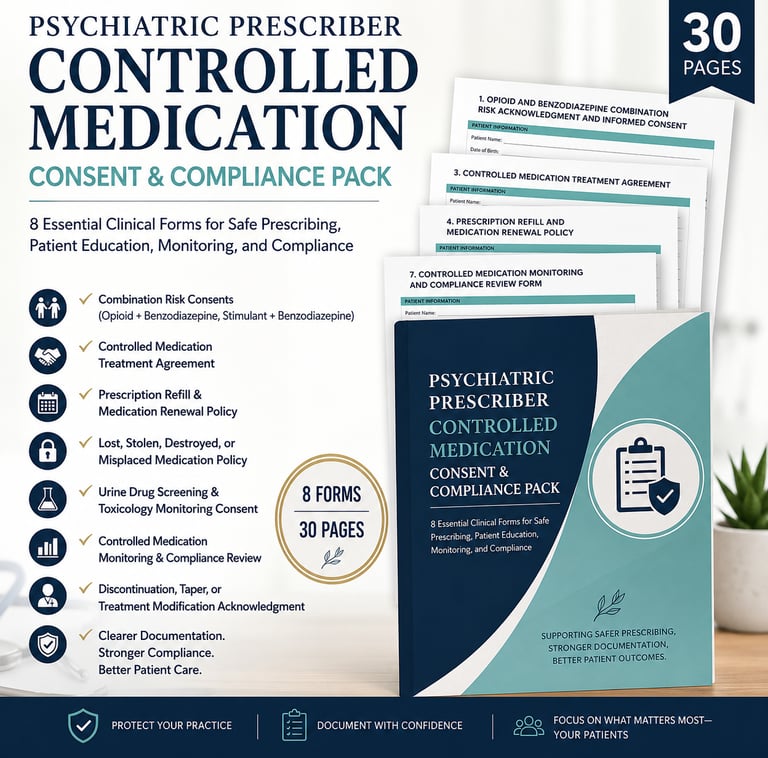
The Psychiatric Prescriber Controlled Medication Consent & Compliance Pack was created to help psychiatric prescribers and behavioral health practices build a more organized approach to controlled medication documentation.
This 30-page collection includes eight coordinated forms covering key points throughout the prescribing process.
The pack includes:
Opioid and Benzodiazepine Combination Risk Acknowledgment and Informed Consent
Stimulant and Benzodiazepine Combination Risk Acknowledgment and Informed Consent
Controlled Medication Treatment Agreement
Prescription Refill and Medication Renewal Policy
Lost, Stolen, Destroyed, or Misplaced Medication Policy and Acknowledgment
Urine Drug Screening and Toxicology Monitoring Consent
Controlled Medication Monitoring and Compliance Review Form
Controlled Medication Discontinuation, Taper, or Treatment Modification Acknowledgment
Together, these forms help practices document patient education, treatment expectations, medication risks, refill policies, monitoring, ongoing clinical rationale, and treatment changes.
Who Is This Pack For?
This resource may be especially useful for:
Psychiatrists.
Psychiatric mental health nurse practitioners.
Behavioral health prescribers.
Outpatient psychiatric practices.
Medication management programs.
Group practices that want more consistent controlled medication workflows.
Organizations developing standardized psychiatric practice forms.
Clinicians looking for more structured psychiatry templates.
Instead of creating individual forms from scratch, practices can begin with a coordinated framework and customize the documents based on applicable laws, licensing requirements, payer expectations, and organizational policies.
The Question Is Not Whether You Will Ever Need the Documentation
The better question is whether the documentation will already exist when you need it.
You do not want to build your refill policy during a patient dispute.
You do not want to reconstruct informed consent after an adverse event.
You do not want to search through years of progress notes trying to prove that controlled medication monitoring occurred.
And you do not want your first attempt at organizing controlled medication documentation to happen after an auditor asks for the chart.
The safest time to strengthen documentation is before there is a problem.
The Psychiatric Prescriber Controlled Medication Consent & Compliance Pack gives practices a practical starting point for creating clearer expectations, stronger documentation, and more consistent controlled medication workflows.
Protect the chart before the chart has to protect you.
These forms are intended as customizable clinical documentation resources. Prescribers and organizations should review all materials for alignment with applicable federal and state laws, professional licensing requirements, controlled substance regulations, payer requirements, and organizational policies. These materials do not constitute legal advice and do not guarantee compliance with any specific regulatory, licensing, or payer requirement.
Frequently Asked Questions About Controlled Medication Documentation
What forms should a psychiatric prescriber use for controlled medications?
Psychiatric prescribers may use a combination of controlled substance agreements, medication-specific informed consent forms, refill and renewal policies, urine drug screening consent forms, medication monitoring forms, and taper or discontinuation documentation. The specific forms used should reflect the clinician’s practice, patient population, applicable law, licensing requirements, and organizational policies.
What is a controlled substance agreement?
A controlled substance agreement is a document that establishes expectations between the patient and prescriber regarding the use of controlled medications. It may address medication adherence, pharmacy use, early refills, medication storage, appointment attendance, prescription monitoring program review, toxicology testing, pill counts, and potential misuse or diversion concerns.
Do psychiatric practices need a controlled medication refill policy?
A written medication refill policy can help psychiatric practices establish consistent expectations for routine refill requests, early refills, after-hours requests, weekends and holidays, pharmacy changes, medication shortages, travel, missed appointments, and lost or stolen medications. Clear policies may also reduce confusion and inconsistent responses from practice staff.
What should be included in a controlled medication consent form?
A controlled medication consent form may include the medication being prescribed, potential risks and benefits, safety precautions, medication interactions, patient responsibilities, emergency warning signs, monitoring expectations, alternative treatment options, and documentation of patient understanding.
Why is an opioid and benzodiazepine consent important?
Concurrent or overlapping opioid and benzodiazepine use can involve significant safety concerns. A structured informed consent can help document that risks, emergency warning signs, overdose considerations, naloxone education, alternatives, monitoring plans, and the clinical rationale for treatment were discussed with the patient.
What should a stimulant and benzodiazepine consent include?
A stimulant and benzodiazepine consent may address potential effects on alertness, sleep, anxiety, mood, cardiovascular symptoms, dependence, misuse, and medication interactions. It can also document the prescriber’s clinical rationale, treatment goals, alternatives considered, and monitoring plan.
What is a urine drug screen consent form?
A urine drug screen consent form explains the purpose and limitations of toxicology monitoring. It may address urine or oral fluid testing, confirmatory testing, false-positive and false-negative results, substance disclosure, specimen concerns, unexpected findings, and how results may affect clinical decision-making.
What should be documented when a controlled medication is lost or stolen?
Practices may document the medication involved, quantity, circumstances of the loss or theft, date reported, whether a police report was filed, and whether the pharmacy or insurance company was notified. The prescriber may also document whether the medication will be replaced and whether additional clinical monitoring or reassessment is needed.
How should psychiatric prescribers document ongoing controlled medication monitoring?
Ongoing documentation may include treatment response, functional improvement, adverse effects, medication adherence, PDMP review, toxicology results, pill counts, early refill requests, outside prescriptions, substance use concerns, misuse or diversion risk, and the clinical rationale for continuing treatment.
What should be documented when tapering or discontinuing a controlled medication?
Documentation may include the reason for the treatment change, clinical rationale, alternative treatments considered, taper schedule, potential withdrawal symptoms, emergency warning signs, follow-up plan, and the patient’s understanding of the change.
Are controlled medication consent forms legally required?
Requirements vary by medication, jurisdiction, licensing board, payer, and practice setting. A form alone does not guarantee regulatory or legal compliance. Prescribers should review their documentation practices against applicable federal and state laws, professional requirements, and organizational policies.
Can these controlled medication forms be customized for my psychiatric practice?
Yes. The Psychiatric Prescriber Controlled Medication Consent & Compliance Pack is designed as a customizable documentation resource. Practices should adapt the forms to their own workflows, prescribing policies, patient population, and applicable regulatory requirements.
Where can I find a psychiatric controlled medication consent and compliance form pack?
The Psychiatric Prescriber Controlled Medication Consent & Compliance Pack includes eight coordinated forms covering controlled medication consent, combination-risk documentation, treatment agreements, prescription refill policies, toxicology monitoring, lost or stolen medication documentation, ongoing compliance review, and taper or discontinuation planning.
Forms
Streamlined templates for mental health documentation needs. These templates are intended for general informational and documentation support purposes only and should be reviewed and adapted to meet individual practice requirements and applicable laws.
© 2023. All rights reserved.