Editable Mental Health Forms for a More Protected, Audit-Ready Practice
The Hidden Financial Risk in Your Therapy Notes
Insurance audits in behavioral health are increasing, and many practices are unknowingly exposed to documentation risk. This article explores how structured internal chart audits can reduce financial clawbacks, strengthen medical necessity alignment, and improve overall compliance defensibility. Learn why a weighted 100-point scoring system transforms documentation review from subjective opinion into measurable compliance strategy and how proactive audit readiness protects both your revenue and your reputation.
2/17/20264 min read
The Hidden Financial Risk in Your Therapy Notes
Why Most Mental Health Practices Are One Audit Away From a Revenue Crisis
Behavioral health audits are no longer rare events. They are routine, data-driven, and increasingly aggressive.
Insurance carriers, Medicaid plans, Medicare contractors, and recovery audit contractors are using advanced analytics to identify patterns such as:
Repetitive documentation
Missing medical necessity language
Mismatched CPT coding
Treatment plans not linked to notes
Lack of measurable progress
Most practices do not realize they have documentation risk until they receive a records request.
By then, the clock is already ticking.
The Real Cost of Poor Documentation
When mental health documentation is incomplete or defensively weak, the consequences can include:
Insurance clawbacks
Recoupment of months of payments
Licensing board scrutiny
Accreditation findings
Increased malpractice vulnerability
Payer contract termination
This is not about formatting.
This is about financial survival.
Even strong clinicians can struggle with compliance alignment if they do not have a structured audit system in place.
The Compliance Blind Spot in Most Behavioral Health Practices
Here is the truth most consultants will not say out loud:
Most internal audits are informal.
A supervisor skims notes.
Someone checks for signatures.
Billing glances at CPT codes.
But very few practices use a weighted, objective compliance scoring system that evaluates:
Administrative documentation
Medical necessity
Treatment plan alignment
CPT justification
Functional impairment
Defensibility under audit
Without a standardized scoring method, audit review becomes subjective and inconsistent.
And inconsistency is risk.
Why a 100-Point Chart Audit Scoring System Changes Everything
A structured scoring tool transforms compliance from opinion into measurable data.
Instead of asking,
“Does this look okay?”
You can ask,
“What is this chart’s compliance risk score?”
A weighted scoring model allows you to:
Identify high-risk clinicians before payers do
Detect cloning patterns early
Quantify documentation quality trends
Track remediation progress
Create objective compliance reports for leadership
This is executive-level compliance management.
Internal Mock Audits: Your Strongest Defense
Before an external auditor ever reviews your records, your practice should already know:
Which charts score below 80
Which clinicians require retraining
Which documentation elements are consistently weak
Where billing alignment is vulnerable
Mock audits are not about catching mistakes.
They are about preventing financial exposure.
Compliance Is No Longer Optional
The behavioral health regulatory environment continues to tighten:
Increased payer scrutiny
Value-based care models
Expanded fraud analytics
Documentation defensibility expectations
More aggressive Medicaid oversight
Practices that treat compliance as an afterthought are taking a financial gamble.
Practices that implement structured audit systems operate with control.
A Practical Solution for Behavioral Health Leaders
If you are serious about reducing audit risk, you need more than a checklist.
You need:
Weighted scoring
Section-based risk thresholds
Medical necessity evaluation
Treatment plan linkage review
CPT alignment analysis
Defensibility criteria
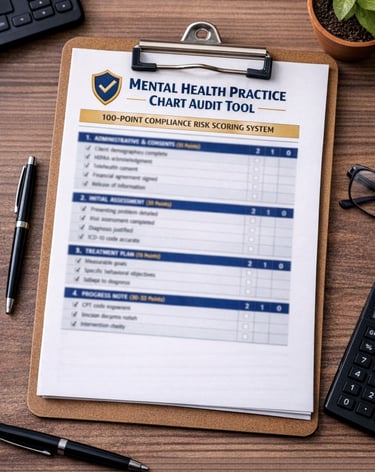
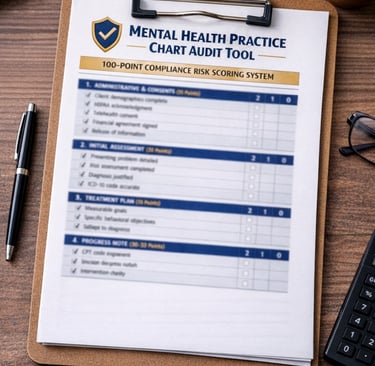
That is exactly what the Mental Health Practice Chart Audit Tool – 100-Point Compliance Risk Scoring System was built to provide.
It allows compliance officers, supervisors, consultants, and practice owners to conduct structured internal audits and generate objective risk scores across:
Administrative documentation
Initial assessments
Treatment plans
Progress notes
Billing & medical necessity
This tool was designed specifically for behavioral health — not adapted from general medical templates.
Who Should Use a Structured Chart Audit Tool?
This is ideal for:
Private practice owners
Group practice executives
Compliance officers
Clinical supervisors
Behavioral health consultants
Organizations preparing for accreditation
If your practice bills insurance, this applies to you.
Stop Hoping Your Charts Are Safe
Hope is not a compliance strategy.
Objective scoring is.
If you want to identify documentation risk before an external auditor does, implement a structured audit process now.
Get your Mental Health Practice Chart Audit Tool – 100-Point Compliance Risk Scoring System
Mental Health Practice Chart Audit Tool
100-Point Compliance Risk Scoring System
If an insurance auditor requested 20 charts from your practice tomorrow… would you feel confident?
Most clinicians believe their documentation is “good enough.”
Most practices are wrong.
The Mental Health Practice Chart Audit Tool is a structured, weighted 100-point compliance scoring system built specifically for behavioral health practices that bill insurance.
This is not a generic checklist.
It is a compliance framework designed to evaluate documentation defensibility, medical necessity alignment, billing integrity, and audit readiness.
What This Tool Evaluates
This structured audit system reviews five critical risk domains:
✔ Administrative & Consent Documentation
HIPAA acknowledgment, telehealth consent, financial agreements, insurance verification, and release of information compliance.
✔ Initial Assessment Integrity
Diagnosis justification, risk assessment, medical necessity statements, ICD-10 accuracy, and symptom documentation.
✔ Treatment Plan Compliance
Measurable goals, behavioral objectives, intervention specificity, linkage to diagnosis, client participation, and review dates.
✔ Progress Note Defensibility
CPT code alignment, session duration match, intervention clarity, client response documentation, treatment plan linkage.
✔ Billing & Medical Necessity Risk
Cloned documentation detection, functional impairment support, frequency justification, standardized tool documentation, and overall audit defensibility.
Each section is weighted and scored 0–2 per item, generating a final compliance risk score out of 100.
Compliance Risk Interpretation
90–100: Audit Ready
80–89: Minor Gaps
70–79: Moderate Risk
Below 70: High Audit Risk – Immediate Corrective Action Recommended
This transforms documentation review from subjective opinion into measurable compliance data.
Why This Tool Matters
Behavioral health practices are facing:
Increased insurance clawbacks
More aggressive Medicaid oversight
Data-driven payer audits
Licensing board scrutiny
Documentation defensibility challenges
Without structured internal audits, most practices do not discover compliance gaps until after financial damage occurs.
This tool helps you identify risk before external auditors do.
Who This Is For
Private practice owners
Group practice executives
Compliance officers
Clinical supervisors
Behavioral health consultants
Organizations preparing for accreditation
If you bill insurance, this tool applies to you.
How You Can Use It
Conduct internal mock audits
Score clinician documentation objectively
Identify high-risk charts
Track remediation progress
Support compliance reporting
Strengthen audit preparedness
What You Receive
Editable Word document
Printable audit scoring form
Structured 100-point weighted scoring system
Built-in compliance risk interpretation scale
Space for reviewer documentation and comments
Compliance is not about perfection.
It is about defensibility.
If you want to protect your revenue, reduce audit exposure, and implement structured internal compliance oversight, this tool gives you a practical, professional system to do exactly that.
Forms
Streamlined templates for mental health documentation needs. These templates are intended for general informational and documentation support purposes only and should be reviewed and adapted to meet individual practice requirements and applicable laws.
© 2023. All rights reserved.